Saakshi Dixit
NIMHANS
Beyond Borders
Designing accessible stroke rehabilitation solutions for rural India through community-centered innovation

Approach
Participatory Design
Strategy
Healthcare Design
UX Research
Behavioural Design
Industrial Design
Ethnographic Research
Sector
Community Health
Impact
Duration & Partner
13 Weeks
NIMHANS
Thesis
The Problem: When Strokes Strike in the Shadows
For over half a century, we've made remarkable strides in understanding stroke care. Yet across rural India, these advances remain a distant reality. Strokes persist across all regions, especially in villages. Communities are left without infrastructure, knowledge, or tools to address them.
Stroke survivors face a critical challenge: while 95% of less severe strokes are survivable, 75% of post-stroke recovery depends on rehabilitation: grounded in the principle of neuroplasticity. Yet in rural areas, this lifeline is largely inaccessible. There are no trained therapists, limited resources, and profound gaps in knowledge about what recovery actually looks like.
The question we set out to answer wasn't just medical it was deeply human:
How can we make rehabilitation accessible to rural India, keeping in mind cost-effectiveness, the absence of therapists, and the reality of how communities actually function?
Phase 1: Medical Grounding
It began with expert consultation at PRS Neuroscience, studying the clinical pathways of stroke diagnosis, treatment, and aftercare. During these visits,I was exposed to rehabilitation tools many of which were simple household items, improvised for therapeutic use.
This sparked a realisation: effective rehabilitation doesn't require expensive medical equipment; it requires thoughtful design around available resources.


Phase 2: Connecting with
Healthcare Networks
To move beyond urban assumptions, we partnered with Ekal Aarogya, a feminist healthcare network operating in remote villages with minimal healthcare infrastructure. Here, local women serve as Sevikas community healthcare workers who sustain health awareness and interventions at the grassroots level.
Phase 3: Ethnographic Research
in Hosapura
The most transformative phase took us to Hosapura, a village where stroke incidence is alarmingly high: one stroke patient for every hundred residents. Yet there was no infrastructure to support them.
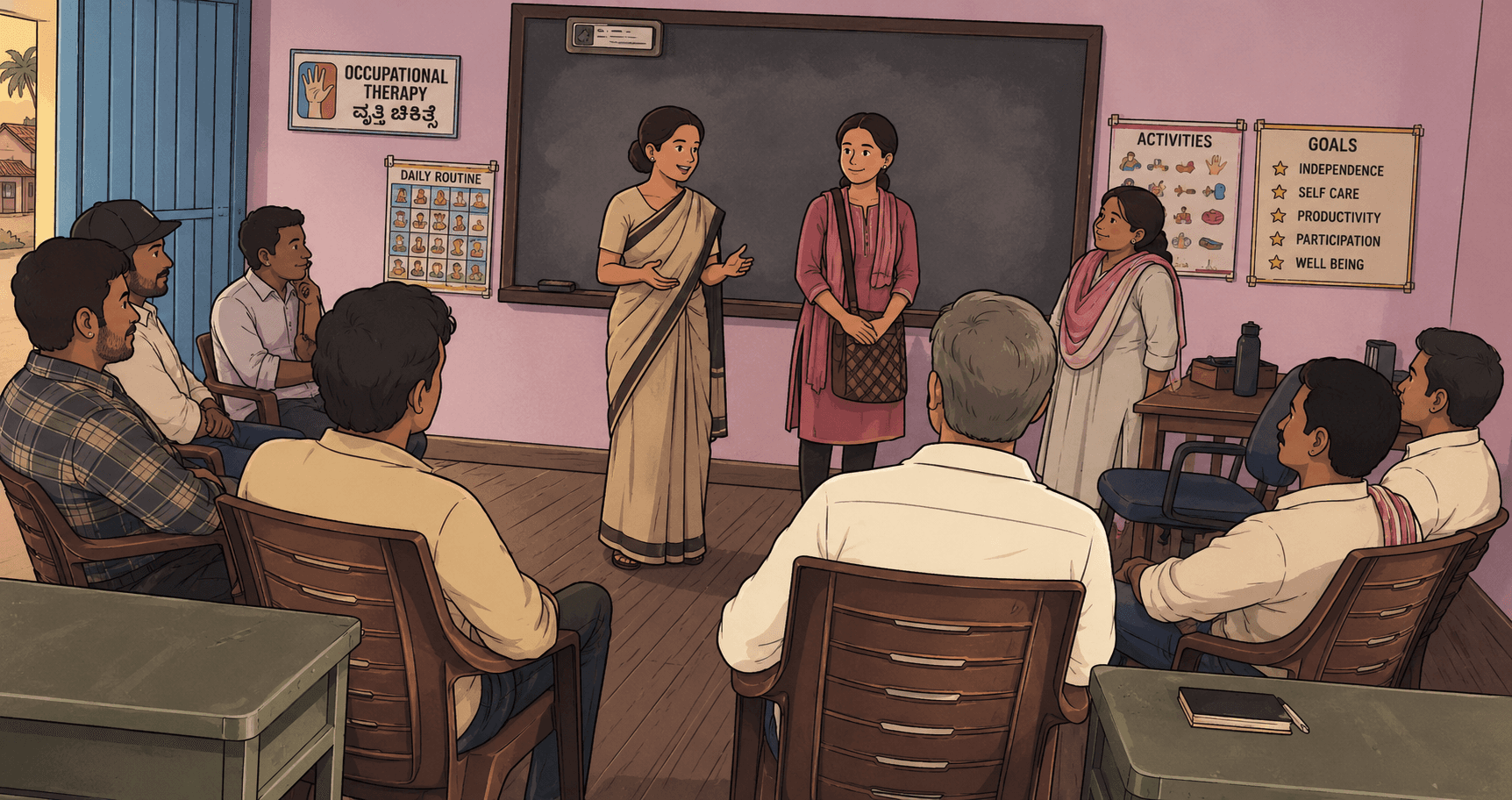
Note: All images so far are AI generated to protect the privacy of the people involved in the study.
What We Learned in Hosapura
A village with 1 stroke patient per 100 residents yet the nearest hospital is 30 minutes away, government doctors visit 4 times a year, and no one knows what post-stroke rehabilitation looks like.
The aftermath, rehabilitation and recovery is where communities struggle most.
The closest hospital is 30 minutes away (closed Sundays). Government health posts exist 2.5-3.5 km away with doctors visiting only 4 times per year. Transport depends on timed buses or expensive autos. No facilities are equipped specifically for stroke care.
Real Barriers
Families fear treatment costs
Operations are expensive and families worry about multiple procedures if paralysis affects multiple body parts. When finances are tight and income depends on manual labor, a single household member's stroke can destabilize entire family economics especially if it's a working male, forcing his wife to become sole earner and caregiver.

Myths Dominate: Strokes "Come in Threes," No Cure
Preconceived notions that are not validated by science guide health decisions: the belief that strokes always return three times, or that a change in jaw shape prevents future strokes. Because many believe strokes are incurable, families see no point in investing time or money in recovery.

Knowledge only spreads through word-of-mouth
Resources and information about stroke care exist only in networks of families who've already experienced stroke. If you haven't been touched by stroke, you don't know help exists. This creates an invisible knowledge gap where most communities remain unaware until crisis hits.
Everyone relies on traditional treatments, over recovery
While Ayurvedic practices (hot milk with garlic, therapeutic oils) help manage blood pressure and cholesterol, they don't address post-stroke rehabilitation. Communities recognize acute stroke symptoms and rush to hospitals, but the aftermath, the recovery phase where 75% of function can be restored & remains completely unsupported.
The Opportunity: Sevikas
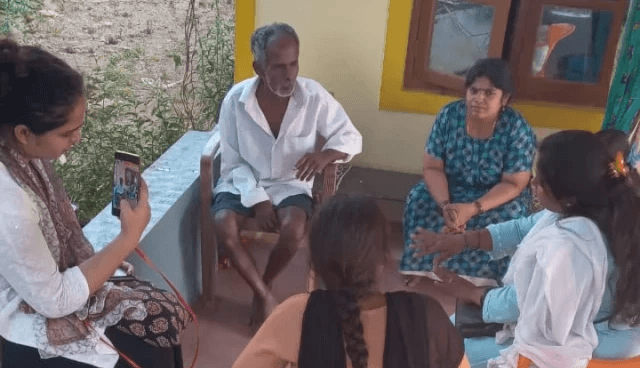
Local women appointed as Sevikas are the de facto healthcare providers in villages.
They are present, trusted, and embedded in community life. They work alongside Asha workers to sustain health awareness.
Yet they lack essential knowledge about stroke recovery, practical tools for rehabilitation, confidence in their caregiving role, and structured guidance for patient support.
If we equipped Sevikas with knowledge and tools, we could transform post-stroke care accessibility.
The Core Challenge
Sevikas are the backbone of post-stroke care in rural communities. Yet they lack the essential knowledge, tools, and confidence to guide rehabilitation effectively.
The Solution
Community Awareness Workshop
Before designing anything, we held a stroke awareness workshop in Hosapura itself. It was an open conversation, covering:
Basic stroke recognition and symptoms
The "golden hour"why the first hours matter
Neuroscience of stroke (breaking down brain function post-stroke)
The concept of Neuroplasticity why rehabilitation works
How the tools we'd create fit into recovery
The conversation that built trust and validated that science could work alongside traditional knowledge.


Thoughtful Tool Design
Every tool addresses specific post-stroke recovery needs:
Sensory Rehabilitation Restoring sensory awareness and processing through touch and texture materials.
Communication Support Visual tools to help stroke survivors regain speech and language abilities.
Repetition & Motivation Tools designed to encourage consistent, motivated practice for neural recovery.
Materials: Locally-available, affordable resources:
MDF, cardboard, hand-painted and laser-cut to precision. Produced locally so any region can adapt it.


Regional Language Documentation
Every guide written in regional languages with visual step-by-step processes:
How to use each tool
How to keep stroke survivors motivated
How to recognize progress
When to escalate to medical professionals

The Toolkit

Why it works?
Respects community knowledge while introducing science
Builds on existing roles rather than creating dependencies
Works with local economics rather than against them
Scales sustainably through local production
Knows when to escalate to medical professionals
NOTION DOCUMENTATION
FOR A DETAILED
DOCUMENTATION
FEEL FREE TO GO
THROUGH THIS :)
(Page 75 onwards
for toolkit details)
CLICK TO READ
How Delivery Hero streamlines marketing reporting across all their brands with Clarisights. How Delivery Hero streamlines marketing reporting across all their brands with Clarisights. How Delivery Hero streamlines marketing reporting across all their brands with Clarisights. How Delivery Hero streamlines marketing reporting across all their brands with Clarisights. How Delivery Hero streamlines marketing reporting across all their brands with Clarisights. How Delivery Hero streamlines marketing reporting across all their brands with Clarisights. How Delivery Hero streamlines marketing reporting across all their brands with Clarisights. How Delivery Hero streamlines marketing reporting across all their brands with Clarisights. How Delivery Hero streamlines marketing reporting across all their brands with Clarisights. How Delivery Hero streamlines marketing reporting across all their brands with Clarisights. How Delivery Hero streamlines marketing reporting across all their brands with Clarisights
This project was chosen as an 'outreach programme initiative' for NIMHANS
© 2026