Saakshi Dixit
Case study · SOCIAL IMPACT · ParallelHQ
A Global AI Use Cases Repository
Social Impact
Global
Discovery-Led
0-1
Funded by Google Org
Role
Associate Product Designer
Timeline
2 wk discovery → prototype
Status
Prototype valid, pre-build · NDA
Team
me+ 1 PD2
The team collaborated directly with the client and google org
I co-owned discovery and design for client's use case platform, turning scattered social-impact knowledge into something funders and implementers could actually search, compare, and trust. The brief had no fixed spec — the direction had to be found before it could be designed. Two weeks of discovery narrowed raw needs into 4 problem themes and 2 core user archetypes, ending in a high-fidelity prototype validated across stakeholder sessions with the client and Google.org.
Google org
funded initiative
Discovery
led design
Prioritisation
in terms of product maturity
Discovery/Problem Framing
Ran a 2 week discovery to look beyond just the product
The brief was open-ended: make sense of the problem space and define what "good" looks like for a global AI use case repository, serving both funders and implementers in the social sector. There was no fixed spec — the direction had to be found before it could be designed.
We started by understanding the brief, the client, and the space itself — mapping it out in FigJam and running repeated stakeholder syncs to realign direction before committing to any solution.
Relevant AI work in the social sector already existed — but almost no one could find it. Language gatekept it, region fragmented it, and keyword search broke the moment someone used the wrong term for a solution that already existed elsewhere.
90+ sticky notes distilled into 4 problem themes
We mapped every user need against every existing gap, then clustered them into 4 core problem statements — each one stress-tested with stakeholders before we let it shape a single feature.

Archetypes & JTBDs
3 user archetypes narrowed to 2, redefined by intent,
not identity
We diverged first, mapping every plausible archetype we could justify from the research. But narrowing them meant thinking like the business, not just the user — which 2 groups could we realistically design and build for right now, given where the product actually was.
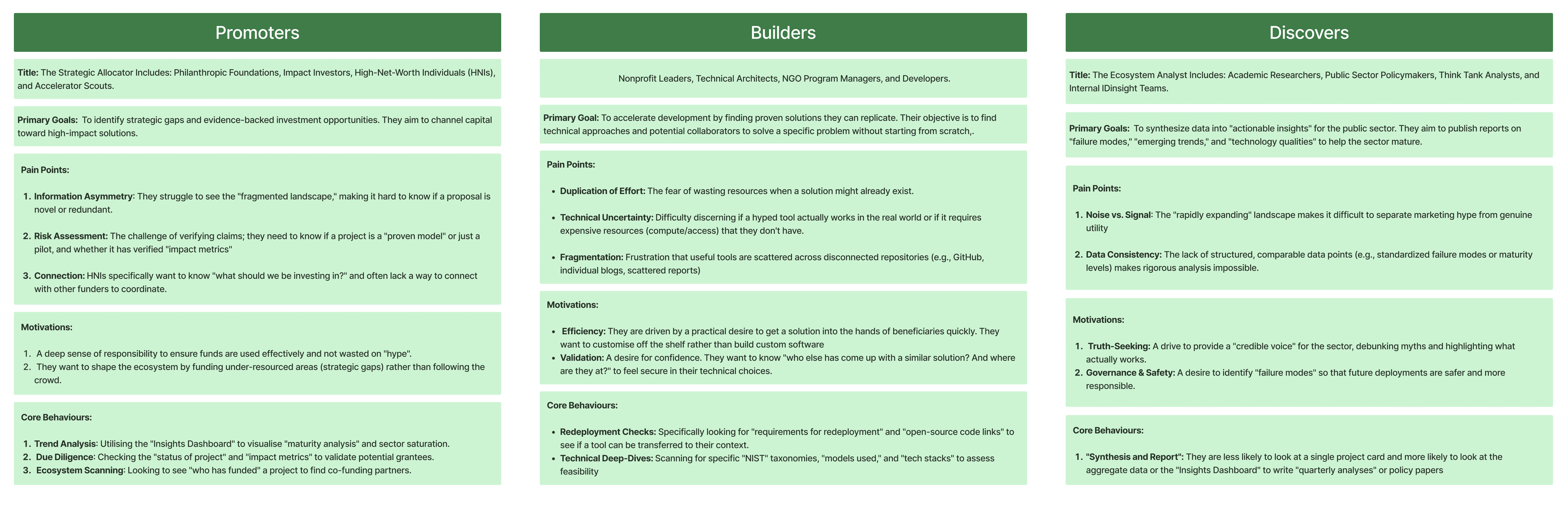
We converged on Implementers and Promoters, reframed around why someone came to the platform rather than who they were — a distinction broad enough to hold real variation within each group without fragmenting our early scope.
Mapping the flow, and the edge case that breaks it,
for every core journey
We traced journeys like an NGO discovering a transferable solution despite not knowing the right terminology, or a funder validating an implementer's credibility before committing capital — and paired each with its edge case, like zero direct matches or unverifiable evidence.
Designing for the break, not just the ideal path, meant the product had to hold up
under real-world ambiguity.

Opportunities
Design for the people who don't know the right keyword yet — the platform had to work for someone searching by outcome, not by the term a specialist would already know.
Audited competitor IA to separate non-negotiables
from differentiators
We reviewed how competitor platforms structured discovery and evidence, marking what every credible platform in the space did well, what they got wrong, and where we had room to differentiate rather than just match.


Features
Feature ideas, each solving a different discovery failure
Feature #1
Chatbot vs. search
Letting users choose conversation or precision depending on how clear their query already was
⚡
Feature #2
⚡
Compare feature
Putting two or more case studies side by side instead of forcing tab-switching
Feature #3
Map view
Browsing AI use cases by geography and sector, for users who didn't yet have the right keyword
⚡
Feature #5
⚡
Text-to-video case summaries
Using AI to compress a case study into a quick watch, so users could tell it was irrelevant in seconds instead of pages
A two-track roadmap: what ships now vs. what earns
its place later
We split scope into two tracks — one scoped tightly to what could ship as P0 given our current build capacity, and one mapping where the product could grow as it matured. Every feature was placed by a mix of build effort, user impact, and how ready the product was to support it.
Outcome
Prototype validated, with a basic design system in place,
ready for next phase
The project reached high-fidelity prototype with a working design system, validated across 8+ stakeholder review sessions with the client and Google.org — with the core discovery and comparison flows tested well enough to move into build.
Real users, real friction, real priorities
We ran usability testing with actual NGOs and funders, documented every point of friction and confusion, and triaged the findings into a prioritized list — so the next build phase starts from evidence, not assumption.
We spoke to multiple organisations like GirlRising, Google Org, Kheyti, Peak Vision during the user testing phase of the final iterations.

This project is under NDA. The name of the initiative is anonymised. Feel free to get in touch to know more :)
© 2026